















An Integration of Xiao-Chaihu-Tang
and Gegen-Tang for Multi-layered Patholog
By Ju Bong Kang, KMD
Actions and Diagnosis
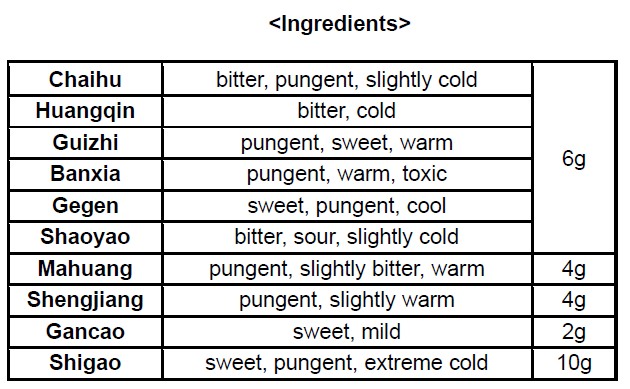 This prescription combines Xiao-Chaihu-Tang and Gegen-Tang and adds Shigao to it; Xiao-Chaihu-Tang treats Shaoyang-Syndrome, Gegen-Tang treats Taiyang-Syndrome, and Shigao treats Yangming’s stomach-heat, respectively. So it improves symptoms such as fever, headache, chills, cold, asthma, muscle pain, and insomnia; and this prescription is used in various febrile diseases covered in modern medicine, such as pneumonia, bronchitis, encephalitis, meningitis, tetanus, smallpox, erysipelas, scarlet fever, hepatitis, summer-heat disease, and others.
The original “Shang Han Liu Shu” has no Mahuang. Asada, a Japanese physician, combined Gegen-Tang and Xiao-Chaihu-Tang into Chaige-Jieji-Tang, enabling broad, practical use. Among the ingredients, Chaihu and Gegen serve as monarch drugs.
Chaihu harmonizes the exterior and interior to treat Shaoyang syndrome, alleviating chest and hypochondrial fullness, alternating chills and fever, bitter taste, tinnitus, fatigue, gastroptosis, prolapse, rib pain, and menstrual irregularity. It may also help with tick disorder, emotional dysregulation, and post-stroke muscle paralysis.
Gegen addresses Taiyang and Yangming syndromes by relaxing muscles, clearing heat, relieving skin eruptions, calming vexation, and stopping diarrhea. It improves headaches, neck and shoulder pain, measles, diarrhea, thirst, and also benefits conditions such as diabetes, arthralgia, internal heat, and insomnia. Pharmacologically, it dilates coronary and cerebral vessels, enhances brain perfusion, and may reduce blood pressure via beta-receptor activity.
Mahuang, Guizhi, Shigao, and Huangqin are minister herbs.
- Mahuang promotes sweating, dispels cold, opens the lungs, and relieves asthma, fever, and edema.
- Guizhi warms and circulates Yang to ease headache, joint/muscle pain, cold extremities, and palpitations.
- Shigao clears Yangming and lung heat, treating thirst, intense fever, restlessness, rash, and sweating.
- Huangqin clears heat and dampness, relieving symptoms such as cough, diarrhea, jaundice, metrorrhagia, and urinary tract issues associated with heat.
Banxia, Shaoyao, Shengjiang, and Gancao act as adjuvants.
- Banxia supports Mahuang in relieving cough, nausea, dizziness, and phlegm-related anxiety.
- Shaoyao conserves Yin and prevents excessive sweating.
- Shengjiang aids digestion and detoxifies Banxia.
- Gancao benefits qi and harmonizes the overall formula.
For diagnosis, palpation reveals:
- Chaihu → chest/hypochondrial fullness
- Gegen → neck/shoulder stiffness
- Mahuang → cough, asthma, edema
- Guizhi → headache, poor urination
- Banxia → nausea, dizziness
- Huangqin → epigastric glomus
Although Shaoyao is included, its muscle-relaxing effect may be subtle. Pulse is typically floating, tense, and rapid. Still, in chronic or deficiency cases, it may be sunken and weak, in which case Fuzi can be added to prevent Yang collapse from Mahuang.
Contents in the Source Text
Treating combined Taiyang–Yangming syndromes with headache, periorbital pain, dry nose, insomnia, chills without sweating, and a slightly full pulse. (“Yi Fang Ji Jie”)
Application
- Diseases that cause high fever due to pneumonia, bronchitis, summer heat disease, COVID-19, etc.
- Cold, or fever of unknown causes, long-term mild fever symptoms due to the aftereffects of the flu.
- Insomnia, insanity, delirium, etc.
Distinction
- Gegen-Tang: Relieves neck and back stiffness, but does not show AECF. In contrast, Chaige-Jieji-Tang presents neck and shoulder stiffness along with AECF and FFOCH.
- Xiao-Chaihu-Tang: Shows AECH or FFOCH, but lacks neck and shoulder muscle stiffness.
- Jiuwei-Qianghuo-Tang: For Chaige-Jieji-Tang-like cases without cough, asthma, or sputum, this formula, or Chaige-Jieji-Tang without Mahuang, is suitable.
- Renshen-Baidu-San: Shares similar indications with Chaige-Jieji-Tang. If shoulder stiffness is present, Gegen may be added. If skin inflammation or suppuration exists, add Jingjie, Lianqiao, and Jiegeng to Chaige-Jieji-Tang.