






Sasang Constitutional Medicine: A Korean Approach to Understanding Mind, Body, and Health
From Personality Patterns to Constitution-Based Treatment — Insights from Donguisusebowon
By Namwook Cho L.Ac.
A Korean medical system that classifies people into four constitutions—Taeyang, Soyang, Taeeum, and Soeum—based on inherent Mind–body traits. This approach not only explains why people think and act differently but also provides tailored guidelines for prevention, treatment, and lifestyle management.
Rooted in Lee Je-ma’s Donguisusebowon, it redefines organ theory, emphasizes relationships in health, and bridges psychology with physical medicine. By identifying a patient’s constitution, clinicians can predict disease patterns and select constitution-specific herbal formulas for more precise, effective care.
A Korean medical system that classifies people into four constitutions—Taeyang, Soyang, Taeeum, and Soeum—based on inherent Mind–body traits. This approach not only explains why people think and act differently but also provides tailored guidelines for prevention, treatment, and lifestyle management.
Rooted in Lee Je-ma’s Donguisusebowon, it redefines organ theory, emphasizes relationships in health, and bridges psychology with physical medicine. By identifying a patient’s constitution, clinicians can predict disease patterns and select constitution-specific herbal formulas for more precise, effective care.
In clinical practice, we meet many people. Over time, familiar patterns emerge: groups of patients who move through the world in similar ways. Some are motivated by honor or status, while others are motivated by money. Some are outgoing and befriend strangers instantly; others are reserved. Why is that?
In modern times, the Myers–Briggs Type Indicator (MBTI) is frequently used to categorize personality traits. Helpful as it is, MBTI mainly describes tendencies; it does not explain why certain behaviors feel easy—even instinctive—for some people. For this reason, Korean Sasang Constitutional Medicine (사상의학, 四象醫學) provides a more comprehensive account, one that also informs the treatment of both mental and physical illnesses.
Constitutional Medicine Around the World
Sasang Constitutional Medicine is a distinctive medical-philosophical system founded in late Joseon by Lee, Je-ma (이제마, 1837–1900), known by his pen name Dongmu (東武). It can be understood within the broader family of “constitutional” models of medicine.
In Hippocratic medicine, influenced by Empedocles’s four elements, the human body was thought to be governed by four humors whose balance determined physiology and pathology—an idea that shaped Western medicine into the 18th century. In 1798, the philosopher Immanuel Kant published Anthropology from a Pragmatic Point of View, delineating four temperaments: sanguine, melancholic, choleric, and phlegmatic.
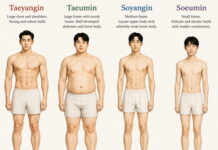
Sasang likewise proposes four constitutions—Taeyang (Greater Yang), Soyang (Lesser Yang), Taeeum (Greater Yin), and Soeum (Lesser Yin)—and holds that each constitution differs in physiology and pathology, the natural course of disease, and the most appropriate modes of treatment, prevention, and daily living. The classic text Donguisusebowon (동의수세보원, “Longevity and Life Preservation in Eastern Medicine”) lays out these theoretical foundations in detail.
Korean Sasang vs. Chinese Medicine
While Chinese medicine is organized primarily around the Five Phases (五行), Sasang is grounded in the Four Phenomena (四象) within a broader ontological ladder: Taiji (太極), Two Modes (yin–yang, 兩儀), Four Phenomena (四象), Mind (心), Mind–Body (心身), and the relational field of Affairs–Mind–Body–Things (事心身物).
Sasang also reframes the internal organs. Instead of the five zangs of Chinese medicine, Sasang emphasizes four zangs —lung (肺), spleen (脾), liver (肝), and kidney (腎)—and four fu: epigastrium/“stomach pouch” (胃脘), stomach (胃), small intestine (小腸), and large intestine (大腸). Another unique feature is the concept of four “dang” (黨)—affinity groupings. For example, the lung-dang (肺黨) encompasses structures and regions associated with the lung, including the esophageal area and esophagus, tongue, ears, brain, skin, hair, and the lungs themselves. Parallel spleen-, liver-, and kidney-dang groupings are also described.
Crucially, whereas much of traditional Chinese medicine emphasizes harmony with Heaven–Earth–Human (天地人)—the human being shaped by and aligned to nature—Sasang centers relationships between oneself and others, and between the self and the external world. Disease is understood to arise from these relational dynamics as much as from environmental influences.
Sasang and Psychology
Because Sasang directs attention to how a person perceives the world and relates to others, it provides practical tools for addressing contemporary psychological and psychiatric concerns in an East Asian medical framework. While Chinese medicine certainly values the Mind relative to biomedicine, Sasang places mind/heart at the center of physiology, pathology, treatment, and cultivation (양생). Its perspective aligns closely with modern understandings of psychosomatic conditions.
For example, depression can occur in any constitution, but is more frequently observed in Soeum types. ADHD likewise appears across all constitutions but is encountered more often in Soyang types. These associations are not diagnostic on their own; instead, they are helpful clues when differentiating a patient’s constitution.
Clinical Use of Sasang
Once a patient’s constitution is determined, Sasang offers a remarkably systematic map: it clarifies characteristic personality traits, suggests likely trajectories of illness, and points directly to constitution-specific herbal prescriptions. For a system developed in the 18th–19th centuries, it is strikingly “manualized.”
The real challenge is accurately diagnosing constitutional issues. Donguisusebowon notes that “if you observe the patient, the constitution becomes evident,” a statement that can feel abstract to modern clinicians. Accordingly, contemporary practice has refined methods that consider body build and pulse-based assessments, among others.
Because herbs and formulas are constitution-specific, a mismatch often yields little benefit—and, on occasion, can cause significant adverse effects. Fortunately, the classics mark contraindicated herbs and formulas by constitution, which gives clinicians safe detours when uncertainty remains. In other words, beginners need not be unduly intimidated, provided they follow these guardrails.
Beginning this month, this column will explore Sasang Constitutional Medicine step by step—pairing clinical experience with close readings of the original Donguisusebowon—to offer practical, clinic-ready insights you can apply immediately.
This column was prepared with reference to Essentials of Sasang Constitutional Medicine by Ryu, Joon Sang, KMD.