











Restoring Kidney Yang and Water Metabolism
in Lower-Body Cold and Edema
By Jubong Kang, KMD
Acts and Diagnosis
Lingjiang-Zhugan-Tang has the functions of warming Yang and promoting diuresis, so to remove coldness of the spleen and lungs, and activate the accumulated water-qi due to coldness at the spleen and lungs. Therefore, this prescription treats the symptoms of frequent urination, dysuria, enuresis, infant bedwetting, coldness of the waist or lower limbs, heaviness of the waist, edema, etc.
In Asian medicine, the term “disturbance of the body fluid metabolism” refers to a condition in which a disorder of body fluid metabolism causes dysuria or edema. This is due to the weakness of the activity of qi. The movement of body fluids and excretion depend on the activity of qi, and this process relies on the activity of qi in the spleen, lung, and kidney. Lingjang-Zhugan-Tang improves the activity of qi in the spleen, lung, and kidney by warming Yang and promoting diuresis, thereby restoring the above-mentioned symptoms.
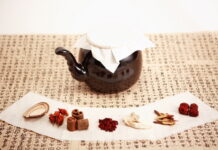
In this prescription, the monarch drug Ganjiang warms the spleen, stomach and lungs, and recuperates the depleted Yang of the organs, and disperses cold and resolves phlegm.
Fuling reinforces the functions of the spleen and kidney as a minister drug, permeates the stagnant body fluid, promotes diuresis, and treats the lower energizer’s water-dampness and edema.
Baizhu invigorates the spleen, dries dampness, and induces diuresis, thus dispersing water-dampness in the middle energizer, relieves edema, and serves as an adjuvant drug.
Gancao benefits qi, mediates the interrelationships of other drugs, and becomes an adjuvant and guiding drug.
That is, the above drugs warm the lung and spleen, and promote diuresis of the stagnant water-qi in the middle and lower energizers, so it cure symptoms such as frequent urination, dysuria, enuresis, edema and others due to “disturbance of body fluid metabolism”.
In diagnosis, the signal-symptom of Fuling, the palpitation around the epigastrium or umbilicus, appears. Since this prescription contains Baizhu, the symptoms of scant urination, edema, and loss of appetite appear.
Ganjiang’s treating symptoms, such as diarrhea, dysuria, edema, nasal discharge, limbs coldness, and a thin and feeble pulse can also be checked to some extent.
Contents in the Source Text
“Shen Zhao Disorder’ produces sluggish body feeling, coldness in the waist, sensation as if sitting in the water, and there is no thirst, incontinence of urine with normal digestion; these belong to the lower energizer’s syndrome. When one experiences fatigue with sweating, wetness, and cold in the clothing, and the illness persists, presenting with cold pain in the lower back and a sensation like a heavy belt around the waist, then Gancao-Ganjiang-Fuling-Baizhu-Tang is indicated”.
Application and Distinction
Frequent urination, dysuria, enuresis, infant bedwetting, strangury, cold feeling of the waist or lower limbs, feeling of heavy waist, edema, etc.
Bawei-Wan(=Shenqi-Wan): Along with frequent urinary symptoms, Bawei-Wan has thirst, decreased vision, and hearing loss due to the deficiency of Yin and Yang of the kidney. Lingjiang-Zhugan-Tang has frequent urinary symptoms, whereas the other does not.
Qingxin-Lianzi-Yin: This prescription addresses dysuria due to lung qi-Yin deficiency, as well as symptoms such as nervousness, facial redness, or chest vexation. However, in Lingjiang-Zhugan-Tang, dysuria is present, whereas symptoms such as nervousness and facial redness are absent.
Buzhong-Yiqi-Tang: For night urination of children with weak digestion and lack of qi, a prescription is used that combines Buzhong-Yiqi-Tang and Lingjiang-Zhugan-Tang and adds astringent drugs to it. The addible astringent drugs include Lianzirou, Qianren, Longgu, Muli, Shanzhuyu, Fupenzi, etc.