










Understanding Its Therapeutic Actions, Clinical Features, and Differential Diagnosis
By Jubong Kang, KMD.
Actions and Diagnosis
Jinshui-Liujun-Jian is a prescription for treating syndromes of Yin-deficiency and phlegm-retention, and this phlegm-retention is produced by overflowing water-qi due to the Yin-deficiency of the lung and kidney. So, this prescription recovers symptoms such as cough, asthma, and dizziness, etc., by combining replenishing-Yin and promoting diuresis to resolve the phlegm.
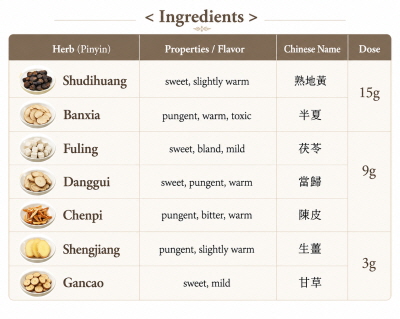 In prescribing methods, using the drugs of supplementing-Yin can make dampness-phlegm, whereas using the drugs of promoting diuresis to resolve phlegm, which removes dampness-phlegm, consumes yin-fluid and can become Yin-deficiency. So, this prescription uses a method of replenishing Yin and blood through Shudihuang and Danggui, and eliminates dampness and phlegm that may occur in this progress along with the dampness-phlegm all together which were originally in the body through Banxia and Fuling.
This prescription was made by combining Shudihuang and Danggui which are constituent drugs of Siwu-Tang with Erchen-Tang. Erchen-Tang has the function of drying dampness and eliminating phlegm, so it treats symptoms of cough, asthma, stuffy nose, nausea, vomit, fullness sensation in the chest, palpitation, dizziness, etc.
Danggui and Shudihuang of Siwu-Tang have functions of replenishing blood and nourishing-Yin, and improve lack of Yin-blood in the lung and kidney. Therefore they recover symptoms of dry of the throat and mouth, dizziness due to blood-deficiency, palpitation, skin dryness, lumber pain, women’s menstrual irregularities and menstrual pain, etc. So, if Shudihuang and Banxia are used together when adding or subtracting prescriptions in clinical practice, this implies the meaning of Jinshui-Liujun-Jian.
Monarch Drugs: Shudihuang and Banxia
Among the constituent drugs of this prescription, Shudihuang and Banxia are monarch drugs.
Shudihuang is two to three times that of other drugs, has the largest dose. This has functions of nourishing Yin-liquid and replenishing blood, so it improves the symptoms such as weakness of the lower back and knee, nocturnal emission, metrorrhagia, diabetes, blurring of vision, deafness, dry cough, cough due to thick sputum, shortness of breath, dyspnea, and various consumptive diseases.
Banxia has the functions of drying dampness and eliminating phlegm. So it alleviates symptoms such as cough and asthma caused by the phlegm, headache due to adverse rising phlegm, chest distention, dizziness, insomnia, borborygmus, as well as whitish and turbid urine, nocturnal emission, and leukorrhea.
Minister Drugs: Fuling and Danggui
Fuling and Danggui become minister drugs.
Fuling has the function of promoting diuresis to resolve dampness; so this increases urine to restore the symptoms such as cough caused by phlegm-retention, edema, abdominal distention, diarrhea, nocturnal emission, stranguria with turbid urine, palpitation due to fright. This assists Shudihuang, a monarch drug, in preventing the dampness-phlegm from stagnating in the process of invigorating Yin and blood and helps the function of Banxia resolve phlegm and eliminate dampness.
Danggui supplements blood, so it aids Shudihuang that nourishes Yin and replenishes blood. In addition, this drug is a minister drug that also functions as an activating circulation of the blood to prevent the formation of a blood-stasis due to the weighty property of Shudihuang.
Adjuvant Drugs: Shengjiang and Gancao
Shengjiang, and Gancao become adjuvant drugs.
Shengjiang is a drug invigorating the stomach, which improves appetite, helps digestion, stops vomiting, and dissolves toxicity of Banxia.
Gancao serves not only as an adjuvant drug by a function of benefit-qi, but also as a guiding drug because it mediates various functions of other drugs by a sweet taste.
Diagnosis
In diagnosis, because there is Shudihuang to improve Yin-deficiency, patients of this prescription often have abdominal-syndrome of subsidence or weakness below the navel, and the surface of the tongue is often fissured. Due to the presence of Banxia and Fuling, a fluid retention or borborygmus may be checked in the stomach and intestines.
If a lot of whitish fur appears, the dose of Banxia can be increased, when the tongue color is light-colored, the dose of Shudihuang can be increased; and if the tongue color is slightly darker or red due to heat of the Yin-deficiency, Shengdihuang can be added.
Contents in the Source Text
If the lung and kidney became deficiency-cold; water-qi overflowed to be phlegm-retention; or they get older so it resulted in a pattern of Yin-deficiency and lacked qi and blood. And if they were infected with wind-cold and had cough and vomited, so it became asthma with a lot of phlegm and an emergency condition happened, then this prescription has an excellent effect. (“Jing Yue Quan Shu”)
Application
Chronic rhinitis, cough, dyspnea; chronic esophagitis with anemia; dizziness due to phlegm-retention or blood-deficiency, etc.
Distinction
- Suzi-Jiangqi-Tang: Both Suji-Jiangqi-Tang and Jinshui-Liujun-Jian are prescriptions to treat the cough of deficiency-pattern, so there are similar aspects in symptoms. However, Jinshui-Liujun-Jian’s cough is caused by phlegm-retention and Yin-deficiency, and Suzi-Jiangqi-Tang’s cough is caused by phlegm-retention in the stomach and epigastrium that blocks qi and blood from rising and falling. So, Banxia and Shudihuang were heavily used in the former, and Banxia, Suzi, and Danggui were used in the latter. Patients with Jinshui-Liujun-Jian, which contains a lot of Shudihuang, usually have good digestion and, compared to this, patients with Suzi-Jiangqi-Tang tend to have moderate or weak digestion.