







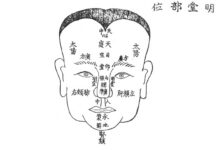









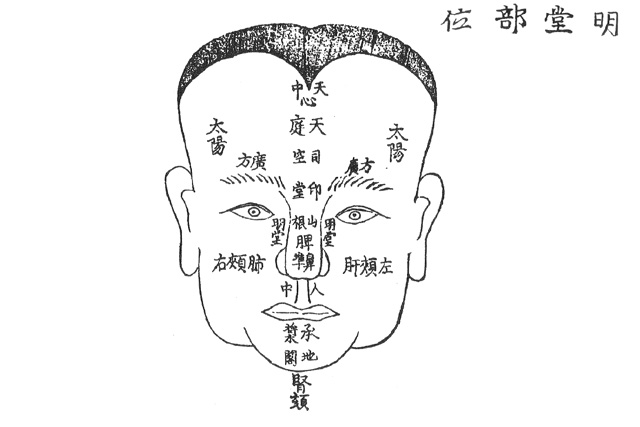
01 Area of Myeongdang (Bright Hall) 明堂部位 명당의 부위
The forehead is called Cheonjeong (天庭, meaning heavenly garden) and it belongs to the heart; the chin is called Jigak (地閣, meaning earthly mansion) and it belongs to the kidneys. The nose is at the center of the face, therefore it belongs to the spleen; the left cheek belongs to the liver, and the right cheek belongs to the lungs. These are the parts of the face which correspond to the five viscera. The color of these parts should be observed to differentiate the disease.
The area where the hair starts to grow right above the nose is called Cheonjung (天中, meaning heavenly middle). The area below Cheonjung (天中, meaning heavenly middle) is called Cheonjeong (天庭, meaning heavenly garden), and it refers to the forehead.
① The area below Cheonjung (天庭, meaning heavenly garden) is called Sagong (司空). Below Sagong (司空) is called Indang (印堂), which is the center of the eyebrows. Below Indang (印堂) is called Sangeun (山根) and it refers to the area between the eyes. Below Sangeun (山根) is called Bijun (鼻準); it is also called Myeongdang (明堂). Below Bijun (鼻準) is called Injung (人中), and below Injung is called Seungjang (a name of an acupoint). Below Seungjang is called Jigak (地閣) and it refers to the chin. The two angles of the forehead is called Bang-gwang (方廣), and it is also called the Taeyang point.
② Cheonjung (天中) and Cheonjung, Sagong and Indang, and Aekgak (額角) and Bang-gwang (方廣) are areas where a prognosis can be observed. These are where the vitality of the patient’s life is exposed, and where doctors do not usually observe thoroughly.
③ Cheonjung (天中), Cheonjung, Sagong, Indang, Aekgak (額角) and Bang-gwang (方廣) are all areas of Myeongmun (命門) where the vitality of the patient’s life is exposed. Looking at these areas allows the doctor to understand the prognosis of disease.
④ The five colors are dependent on Myungdang; this refers to the nose. If the color of Myungdang is blue or black, it implies pain; if it is yellow or red, it implies fever; if it is white, it implies cold.
⑤ Feel the movement of the pulse, examine BL1, observe the five colors to decide excess and lack in the five visceral qi, strength and weakness of the six bowels, and ups and downs of the body form. In whole, observe these to decide the chances of life and death of the patient. It is said in the Annotation, “BL1 is the name of an acupoint located at the medial area of both eyes.”
⑥ The way of diagnosing diseases from observing Myungdang is mentioned in detail in the chapter Detection.
02 Face Is Where All Yang Is Gathered 面爲諸陽之會 얼굴은 양이 모두 모이는 곳이다
① It is said in the Divine Pivot (靈樞), “The three hand yang meridians flow from the hands to the head.”
② The hand greater yang meridian flows starting from the supraclavicular fossa, through the neck, up to the cheeks and ending at the lateral sides of the eyes. The hand lesser yang meridian flows starting from the supraclavicular fossa, through the anterior part of the neck, reaching the upmost tip of the ears, circling the cheeks and reaching down to the zygomatic bone. The hand yang brightness meridian flows starting from the supraclavicular fossa, through the anterior part of the neck, penetrating through the cheeks, intersecting left and right in the philtrum and flows right beside the nose. These three are the meridians flowing from the hands.
③ In the Divine Pivot (靈樞), it says, “The three feet yang meridians flow from the head to feet.”
④ The food greater yang meridian starts from the medial sides of the eyes, moves upward to the forehead, and meets at the top of the head. The foot lesser yang meridian starts from the medial sides of the eyes and moves up to the angles of the head. The foot yang brightness meridian starts from the nose and crosses at the ridge of the nose.” These three meridians are the ones flowing from the face to feet.”
⑤ The six yang meridians of the hands and feet all gather in the face.
03 Face Can Endure Cold 人面耐寒 얼굴이 추위를 견디는 이유
① Huangdi (黃帝) asked, “The face and body are connected with bones and sinew, and also through blood and qi. Earth cracks and ice forms when the weather is cold; likewise, hands and feet become unable to move when the weather gets cold suddenly. However, the face does not need to be covered with clothing; why is it so?” Qibo answered, “The twelve meridians and blood-qi of three hundred sixty five collaterals go upward to the face and flow through the orifices. The yang qi among the essence qi flows into the eyes and enables it to see, and divides from there and flows into the ears to enable hearing. Ancestral qi flows up to the nose and enables the sense of smell. Turbid qi originates from the stomach and flows into the mouth and tongue; it enables the sense of taste. The humor and fluid from these qi all flow up to the face and warm it. Also, the skin on the face is thick and the flesh is firm. This is why face is able to withstand severe heat and cold.”
② Only the face is able to withstand cold, why is it so? The head is where all yang meridians gather. All yin meridians flow up to the neck and move downwards again, but yang meridians flow up to the headit is why the face is able to withstand cold.
04 Diseases of the Face Pertain to the Stomach 面病專屬胃 얼굴 병은 오로지 위에 속한다
The six yang meridians of the hand and feet all go up to the head, but the foot yang brightness meridian originates from the nose and intersects on the ridge of the nose, and enters the upper teeth and circles the mouth, passes ST6, flows in front of the ear and passes GB3. Since the foot yang brightness meridian flows throughout the face like a net, diseases on the face are related only to the stomach. Symptoms like swelling of the face from wind-heat, purplish face or nose, pimples or rashes, flushed face, or cold face are symptoms of the stomach and should be treated as such.
05 Size of the Face 面部度數 얼굴의 치수
The distance between the two zygomatic bones is 7 chon.
06 Heat on the Face 面熱 얼굴에서 열이 나는 것
① Heat on the face is the disease of foot yang brightness.
② Redness of the face as if drunk is caused by stomach heat flowing upwards and heating the face.
③ Heat on the face is caused by the stagnation of heat.
④ Heat on the face is a disease of the stomach.
⑤ The stomach gets diseased when one does not restrain from overeating. A diseased stomach induces dyspnea, loss of consciousness, and severe fever. The fever may flare up from inside to the surface of the face.
⑥ A patient felt heat on the face, and the pulse was surging and large with force. It was caused from rich flavored and greasy food leading to excess heat in the yang brightness meridian, which has sufficient blood and qi. Use seven dons of a Regulate Stomach and Coordinate Qi Decoction with 3 don of Coptidis Rhizoma (黃連) and 1 don of Rhinocertis Cornu (犀角). This prescription will induce diarrhea two to three times; afterwards a Cimicifuga and Coptis Decoction should be prescribed and the symptoms will be cured.
• Cimicifuga and Coptis Decoction 升麻黃連湯 승마황련탕: It treats heat on the face. Prepare one don of Cimicifugae Rhizoma (升麻) and Puerariae Radix (葛根), seven pun of Angelicae Dahuricae Radix (白芷), five pun of Paeoniae Radix Alba (白芍藥) and Glycyrrhizae Radix (甘草), four pun of Coptidis Rhizoma (黃連) (stir-fried in alcohol), and three pun of Rhinocertis Cornu (犀角) (ground into powder), Cnidii Rhizoma (川芎), Schizonepetae Spica (荊芥穗), and Menthae Herba (薄荷). Cut these herbs into pieces, soak the Cnidii Rhizoma (川芎), Schizonepetae Spica (荊芥穗) and Menthae Herba (薄荷) in a half-full cup of water, and put the rest of the herbs in one bag and decoct until two cups of water become one. Add the three herbs into the decoction and decoct again until the result becomes 7 pun in amount. Remove the residue, heat the decoction and take it after meals. Avoid alcohol, flour, and the five major pungent foods.
07 Coldness in the Face 面寒 얼굴이 시린 것
① Feeling cold in the face is a sign of a stomach deficiency.
② The face cannot endure coldness if there is cold-dampness in the stomach. First, prescribe an Aconite Order Center Decoction And then a Cimicifuga and Aconite Decoction.
③ An old female monk was not able to stand wind because the face felt too cold, and no one could cure her even after various treatments. She was old, and her qi did not extend throughout her body well because she ate too much fruit and drank too much tea. She was cured after being prescribed an Aconite Order Center Decoction to warm the middle qi (中氣) and then a Cimicifuga and Aconite Decoction.
• Cimicifuga and Aconite Decoction 升麻附子湯 승마부자탕: ① It treats cold in the face. Prepare seven pun of Cimicifugae Rhizoma (升麻), Aconiti Lateralis Radix Preparata (附子) (wrapped in oil paper and roasted), Puerariae Radix (葛根), Angelicae Dahuricae Radix (白芷), and Astragali Radix (黃芪) (soaked in honey and stir-fried), 5 pun of Ginseng Radix (人參), Alpiniae Katsumadaii Semen (草豆蔲), and Glycyrrhizae Radix (甘草) (roasted), and 3 pun of Alpiniae Oxyphyllae Fructus (益智仁). Cut these herbs in pieces, put together in one bag and decoct with three Allii Fistulosi Bulbus (葱白). Take before meals.
② A Cimicifuga and Kudzu Decoction is the most effective medicine for the stomach (which is yang brightness). To treat heat in the face, add Coptidis Rhizoma (黃連), Rhinocertis Cornu (犀角), Angelicae Dahuricae Radix (白芷), Cnidii Rhizoma (川芎), Schizonepetae Spica (荊芥) and Menthae Herba (薄荷). To treat cold in the face, add Aconiti Lateralis Radix Preparata (附子), Angelicae Dahuricae Radix (白芷), Astragali Radix (黃芪), Ginseng Radix (人參), Alpiniae Katsumadaii Semen (草豆蔲) and Alpiniae Oxyphyllae Fructus (益智仁). These are all treated based on the same prescription because both cold and heat in the face are originally the disease of the stomach.
08 Five Colors on the Face 面見五色 얼굴에 오색이 보이는 것
① The outward symptoms of liver problems are the color blue shown on the face and getting angry frequently. The outward symptoms of heart problems are redness on the face and frequent laughter. Outward symptoms of spleen problems are a yellow face and frequent burping. Outward symptoms of lung problems are a pale face and frequent sneezing. Outward symptoms of kidney problems are a dark face and frequent yawning.
② When the foot reverting yin meridian is diseased, the face looks dirty with a bad complexion. When the foot lesser yang meridian is diseased, the face looks unclean; when the hand reverting yin meridian is diseased, the face becomes red. When the foot lesser yin meridian is diseased, the face becomes as dark as charcoal. When the foot yang brightness meridian is diseased, the face becomes dark.
③ When the qi of greater yang becomes exhausted, the face gets pale and expiry sweat comes out from the face. When the qi of lesser yin becomes exhausted, the face gets dark and teeth become bare and dirty. When the qi of greater yin becomes exhausted, the face gets dark and skin and hair become dry.
④ When the wrist pulse is faint and rough, faintness implies the exhaustion of defense qi and roughness implies the exhaustion of nutrient and blood. When defense qi is exhausted, the face becomes yellow; when nutrient and blood are exhausted, the face becomes blue. Also, when both yin and yang are exhausted, the face becomes pale and blue.
⑤ When the face and lips become dark and purple, a Cimicifuga and Angelica Root Decoction should be prescribed.
⑥ A woman could not control her daily meals due to stress and worry. Her face became dark and sheen disappeared, especially on her lips. She felt emptiness in her chest that she felt hunger. Yang qi of the heart and lungs became deficient which caused problems in the circulation of nutrients and blood, and that led to the lack of sheen on her face. Yin qi of the liver and kidneys overflowed to the yang area of the body which led her face to become dark. Also, the condition of the spleen is shown on the mouth and since her state was Water overcontrolling Earth, her lips were dark and purple. Therefore, the doctor used a Flow Harmoniously and Smooth the Qi Decoction to help qi of growth and nurturing in yang brightness and after a few doses she was recovered.
⑦ A patient’s face was suddenly full of darkness. Doctor Sohn diagnosed and said, “This is not a disease. Dirty qi from a bad odor is stuck on the face and is not being dispersed, which caused the darkness in the face.” He asked the patient, “Did you smell a very bad odor and was unable to avoid it about a month ago?” and the patient answered, “I went to use the toilet one day, and it smelled very bad. I stayed there for quite some time and got out; I started to have the disease the day after.” Sun Zhao (孫兆) said, “To remove bad odor, strong fragrance is the best. Break 1 nyang of Aquillariae Lignum (沈香) and Santali Lignum (檀香), burn it on the stove, and smell the fumes; do not let the fragrant smell go out of the curtains and sit neatly near the fragrance. Close your eyes and sit silently. When the fragrance is gone, it’s okay to move outside the curtains.” The patient followed his advice and smelled the fragrance. The shade of his face changed gradually and became normal in ten days. The smell of the kidneys is rotten, and smell of the spleen is fragrant; this was caused because the spleen wins over the kidneys.
• Flow Harmoniously and Smooth the Qi 冲和順氣湯 충화순기탕: ① Prepare 1.5 don of Puerariae Radix (葛根), one don of Cimicifugae Rhizoma (升麻), Angelicae Dahuricae Radix (白芷), Saposhnikoviae Radix (防風), eight pun of Astragali Radix (黃芪), 7 pun of Ginseng Radix (人參), 4 pun of Glycyrrhizae Radix (甘草), and 3 pun of Paeoniae Radix Alba (白芍藥) and Atractylodis Rhizoma (蒼朮). Cut these herbs into pieces, put them in one bag and decoct in water, with 3 pieces of Zingiberis Rhizoma Crudus (生薑) and 2 pieces of Zizyphi Fructus (大棗). Drink the decoction between breakfast and lunch.
② This is the same prescription as the Cimicifuga and Angelica Root Decoction in the Medical Mirror of Past and Present (醫鑑).