











By Namwook Cho, L.Ac
Rooted in Neo-Confucianism, Sasang Constitutional Medicine unites body, mind, and social harmony. Originating in early Joseon, it teaches that true health depends as much on emotional and psychological balance—and our roles and relationships—as on the body itself.
SCM also views food as medicine. Because each constitutional type has different organ strengths and weaknesses, the right diet can calm excess and support deficiency. In this issue, we explore how personality and emotional tendencies shape illness, how inner balance can be restored through self-cultivation, and which foods best support each constitution according to Donguisusebowon (The Principle of Life Preservation in Oriental Medicine).
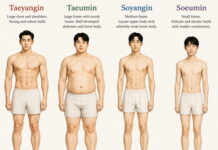
Sasang Constitutional Medicine (SCM) is a Korean system that links body type with personality, emotion, diet, and disease. Unlike traditional Chinese medicine, it highlights psychological and emotional factors, making it an early form of Korean medical psychology. Rooted in “Yak-Sik Dong-Won” (food and medicine share one origin), SCM guides people to choose foods that reinforce weak organs and temper excess, forming the basis of Yangsaeng—traditional Korean well-being and longevity.
Personality and Emotional Traits by Constitution
Every constitution is defined by its inborn temperament, which manifests as characteristic emotional tendencies.
Tae-Yang (Greater Yang) individuals are ambitious, forward-driven, and communicative. They dislike retreating and often pursue progress with intensity. However, they are prone to deep sadness, which, if unresolved, can turn into anger and eventually manifest as physical illness.
So-Yang (Lesser Yang) types are energetic, quick-thinking, and efficient in handling tasks. Yet they tend to become easily irritated, and if this emotion persists, it transforms into melancholy. Their minds are always turned outward, making inner balance essential.
Tae-Eum (Greater Yin) individuals prefer calm and stability. They value preserving what they already have rather than competing for external success. Born with a naturally cheerful and contented disposition, they must avoid overindulgence in pleasure, which can overheat the liver and dry the lungs — a classic pathological pattern in this type.
So-Eum (Lesser Yin) individuals are home-oriented, introspective, and gentle. They share the Tae-Eum’s pleasant nature, but their joy is more fleeting. While the Tae-Eum’s Rak (樂) reflects deep harmony and inner peace, the So-Eum’s Hee (喜) is momentary and situational. They excel in forming close, lasting relationships, but when they become overly focused on pleasure, anxiety and digestive issues often follow.
Emotional Fixation and “Hangshim” (恒心)
In SCM, each constitution has a dominant emotion that can become excessive, a state referred to as “Hangshim”, or emotional fixation.
When a particular emotion persists too long, it disturbs both mind and body balance.
- Tae-Yang: impatience and haste
- So-Yang: rational fear (Gu, 懼)
- Tae-Eum: timid fear (Gyeob, 怯)
- So-Eum: anxiety and instability
While the fears of So-Yang and Tae-Eum appear similar, they differ fundamentally.
So-Yang’s fear arises from logical awareness of risk, whereas Tae-Eum’s fear stems from inner weakness and lack of confidence.
Emotional Balance in Clinical Practice
These emotional tendencies are clearly reflected in clinical observation.
So-Eum patients often struggle with restlessness, excessive thinking, and insomnia. In such cases, calming the mind should precede physical treatment.
For Tae-Yang patients, anger and impatience must first be soothed through counseling and relaxation before acupuncture or herbal therapy is applied.
For Tae-Eum types, therapy should focus on reducing greed and restoring inner calm to protect the lung from dryness caused by excessive liver heat.
In all cases, emotional stability enhances the therapeutic effect of acupuncture and herbal treatment, aligning the mental and physical aspects of healing.
Food Therapy and Constitutional Diet
In the Sasang system, food is viewed not only as nutrition but as a tool for achieving harmony between the body and the mind.
Proper diet serves both as preventive care and as a complementary therapy.
Tae-Yang Type: Prefers cool, light foods.
Recommended: buckwheat, seafood, vegetables, pine needles, grapes, cherries, quince.
Avoid: hot, spicy, and oily foods.
So-Yang Type: Has warm digestion; benefits from cool, fresh foods.
Recommended: barley, red beans, mung beans, sesame, pork, duck, napa cabbage, cucumber, lettuce, pumpkin, watermelon, banana, pineapple, small amounts of beer.
Avoid: chicken, goat, milk, garlic, ginger, curry, and pepper.
Tae-Eum Type: Strong digestion; thrives on protein and rich foods.
Recommended: wheat, soybeans, brown rice, tofu, beef, milk, butter, radish, burdock, lotus root, mushrooms, chestnuts, walnuts, pears, plums, apricots.
Avoid: spicy foods, chicken, pork, garlic, coffee, honey, and eggs.
So-Eum Type: Weaker digestion; light spices aid appetite and warmth.
Recommended: glutinous rice, millet, potatoes, chicken, lamb, spinach, cabbage, leeks, green onions, garlic, ginger, pepper, curry, apples, tangerines, peaches, jujube, honey.
Avoid: pork, cold noodles, watermelon, melon, milk, wheat, barley, and mung beans.
Mind and Food in Harmony
The essence of Sasang Constitutional Medicine lies not in labeling body types but in guiding people toward harmony of emotions, food, and lifestyle.
To live in accordance with one’s constitution is to nurture both body and mind — the true meaning of Yangsaeng, or the “art of nurturing life.”
Through emotional balance and proper diet, anyone can cultivate lasting health and inner peace.