












Oncheongeum for Bleeding with Blood Deficiency, Hwangryunhaedok-tang for Excess Heat
By Jubong Kang, KMD
Actions and Diagnosis
 Wenqing-Yin is a combination of Siwu-Tang and Huanglian-Jiedu-Tang. It treats metrorrhagia and various types of bleeding caused by heat-evil and damp-heat in the triple energizer and organs. It is also used for skin flare, atopy, itching, hives, rash, liver spots, mouth ulcers, and genital ulcers.
“Dong Yi Bo Gam” states that when damp-heat accumulates in the lower energizer and causes dark-red, foul-smelling metrorrhagia, Jiedu-Siwu-Tang, Liangxue-Dihuang-Tang, and Gujing-Wan may be used. Jiedu-Siwu-Tang is another name for Wenqing-Yin.
The heat syndrome seen in Wenqing-Yin patients may develop after a febrile illness, but it can also result from chronic stress, overwork, heavy drinking, and similar causes. Excessive activity may consume body fluids and make the blood more concentrated, while high-calorie foods may contribute to turbid blood and damp-heat.
In Wenqing-Yin, Huanglian-Jiedu-Tang clears heat-evil, heat-toxin, and damp-evil, while Siwu-Tang improves blood deficiency, blood stasis, and bleeding. Together, they are used for bleeding as well as atopy, oral inflammation, and ulcers of the skin and mucous membranes.
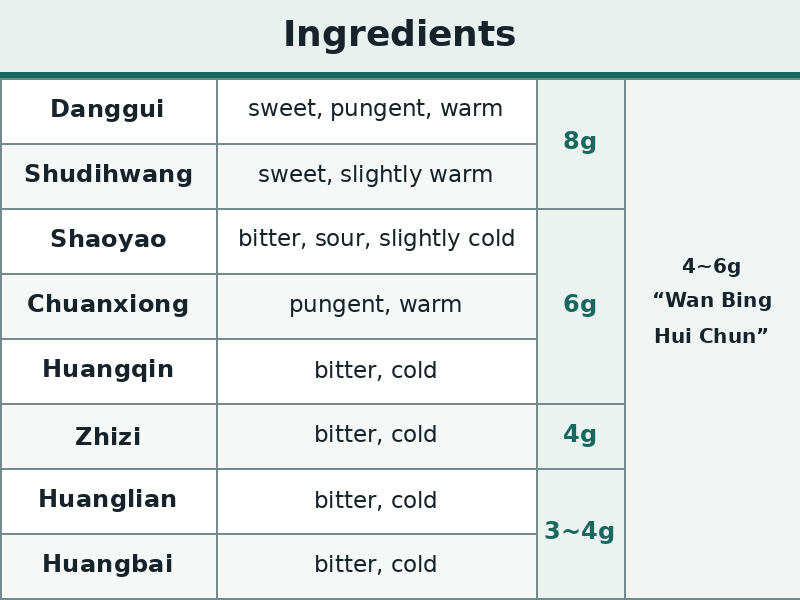
The relative roles of the herbs vary according to dosage. In “Zhen Liao Yao Fang,” the Siwu-Tang herbs are used in larger amounts. In “Wan Bing Hui Chun,” all herbs are given at the same dose of 4.5 g, allowing the Huanglian-Jiedu-Tang herbs to take a more prominent role. The discussion here follows “Wan Bing Hui Chun.”
Huangqin and Huanglian are the monarch herbs. Huangqin clears heat, detoxifies, dries dampness, and stops bleeding. It is used for damp-heat fever, lung heat, jaundice, diarrhea, metrorrhagia, and other bleeding caused by blood-heat. Huanglian clears heat, dries dampness, purges fire, and detoxifies, and is used for high fever, vexation, dysentery, bloody stool, eczema, hematemesis, nosebleed, carbuncles, and abscesses.
Zhizi and Huangbai serve as minister herbs. Zhizi purges fire, clears heat, cools the blood, and detoxifies. Huangbai purges fire, dries dampness, clears heat, and detoxifies, and is used for damp-heat conditions such as yellowish leucorrhea, jaundice, and boils.
Shudihuang, Danggui, Shaoyao, and Chuanxiong are the adjuvant herbs. They nourish and move the blood, support yin, relieve pain and spasm, and promote circulation. Together, they address blood deficiency, menstrual disorders, metrorrhagia, dry skin, pain, and dizziness.
In summary, Huangqin and Huanglian clear heat from the upper and middle energizers, Zhizi clears heat from the triple energizer, and Huangbai removes heat from the lower energizer. Together with Siwu-Tang, they clear heat and toxin from the blood while supporting the blood, thereby relieving bleeding and skin disorders.
On abdominal examination, a Wenqing-Yin patient may show slight fullness and tension below the costal arch. This can resemble Xiao-Chaihu-Tang or Da-Chaihu-Tang, so other findings should also be compared. Wenqing-Yin usually does not present with marked epigastric hardness, and the fullness tends to appear more anteriorly along the Yangming region than laterally along the Shaoyang region.
The complexion may be somewhat red, the abdomen is not particularly weak, and the skin tends to be dry. Skin inflammation often appears as dry eczema or dermatographia, and pruritus is frequently worse at night.
Contents in the Source Text
This prescription treats persistent menstrual bleeding, black or discolored discharge, a yellowish complexion, stabbing lower abdominal pain, alternating fever and chills, and continuing uterine bleeding. “Wan Bing Hui Chun”
Application
- Eczema, pruritus, hives, acne, freckles, chloasma, Behcet’s disease, and vulvar ulcers
- Uterine bleeding, nosebleed, vomiting of blood, and hemoptysis
Distinction
- Huanglian-Jiedu-Tang: Its bleeding pattern is an excess syndrome caused by dominant heat and fire in the triple energizer. The abdomen tends to be firm, the pulse is powerful, and the tongue is red with a dry yellow coating. In contrast, Wenqing-Yin includes a blood-deficiency component, so the abdomen is generally not as firm.
- Xionggui-Jiaoai-Tang: Its bleeding is associated with blood deficiency and impaired blood circulation. The complexion and tongue tend to be pale, and the abdominal muscles are weak and soft.
- Huangtu-Tang: Its bleeding tends to be more chronic and deficient. In terms of deficiency and excess, the order from more excessive to more deficient can be viewed as Huanglian-Jiedu-Tang, Wenqing-Yin, Xionggui-Jiaoai-Tang, and Huangtu-Tang.
- Guipi-Tang: This is appropriate when uterine bleeding is associated with insufficient nourishment resulting from stress or poor appetite. The pulse is thin and sunken, the abdomen is weak, and the complexion tends to be pale and yellowish.


