












Written By Jun Heo (許浚, 1539~1615), translated by Namil Kim, Wung Seok Cha et al. Published by Ministry of Health & Welfare (Korea)
01 Eyes Are Where Essence of the Five Viscera and Six Bowels Gather 眼爲臟腑之精 눈은 장부의 정이 모인 곳이다
① The essence qi of the five viscera and six bowels all ascend to the eyes and are manifested in the eyes. Therefore, eyes are the shelter of the essence of five viscera. The essence of bones becomes the pupils; the essence of sinew becomes the black part. The essence of blood becomes the veins in the eyes; the essence of qi becomes the white of the eyes. The essence of flesh becomes the eyelids; they collect the essence of sinew, bones, blood, and qi, then follow the veins and go up to the brain, and flow down to the neck. This is why pathogenic qi attacks through the neck, goes for the weak parts of the body and if it goes deep inside the body, it goes to the eyes (目系) and to the brain. If pathogenic qi goes to the brain, dizziness occurs; when dizziness occurs, the eyes feel stretched; when the eyes feel stretched, one feels as if one is about to faint and feels dizzy. When pathogenic qi goes to the essence, the essence gets weak and scatters. When the essence scatters, the eyesight becomes dim; when this happens, things are seen in double. Eyes are the place where the essence of the five viscera and six bowels are gathered; the place where nutrient and blood, defense qi, and the corporeal and ethereal soul stay; a place where spirit qi is born. Therefore, if the spirit is tired, the corporeal and ethereal souls will scatter and the will gets dim. The pupils and blacks of the eyes inherit yin and the whites and veins inherit yang. Yin and yang gather together to form essential brightness. Eyes are the servant of the heart, and the heart is where spirit stays; if the spirit-essence gets dizzy and so the eyes do not work properly, odd things will suddenly appear in front of the eyes. This is because the spirit and corporeal and ethereal souls scatter and do not harmonize; this state is what they call ‘charmed’.
② The blood qi is inherited from spleen-Earth. It goes up to the eyes through the five viscera and six bowels, twelve meridians, and 365 veins which makes the bright eyesight of the eyes. Therefore, if the spleen is deficient, the essence qi of the eyes is not able to go up to the eyes, which makes the eyesight dim.
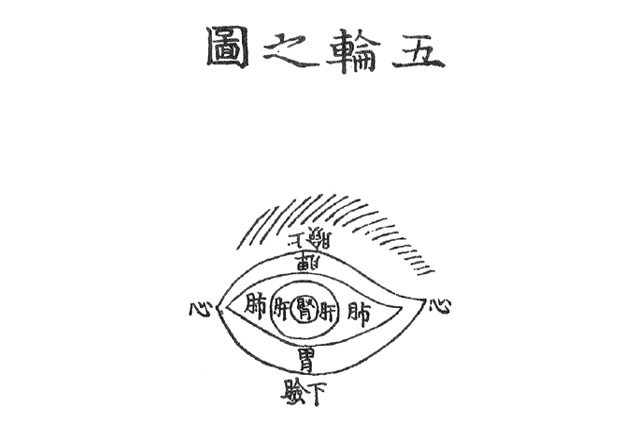
02 The Diagram of Five Wheels 五輪之圖 오륜도
① The whites of the eyes belong to the lungs, and they are called Gi-ryoon (氣輪, wheel of qi) because it is where the essence of qi is gathered.
② The blacks of the eyes belong to the liver, and they are called Poong-ryoon (風輪, wheel of wind) because it is where the essence of sinew is gathered.
③ The upper eyelids belong to the spleen, and they are called Yook-ryoon (肉輪, wheel of flesh) because it is where the essence of flesh is gathered.
④ The inner and outer corner of the eyes belong to the heart, and they are called Hyul-ryoon (血輪, wheel of blood) because it is where the essence of blood is gathered.
⑤ The pupils belong to the kidneys, and they are called Shu-ryoon (水輪, wheel of Water) because it is where the essence of bones is gathered.
02-1 Gi-ryoon (氣輪, Wheel of Qi) 氣輪 기륜
The disease of Gi-ryoon (氣輪, wheel of qi) is caused by damage from winter coldness or summer heat, or pathogenic cold that invaded the weakness of body after drinking cold drinks. The symptoms are pain and dizziness. When the pathogenic qi invades the body, the sinew are often red and swollen; eyes look murky as if the sun is clouded with fog, and when the patient looks at things, they look dim as if it is smokey. If a white nebula covers the eyes due to long period of sickness, the eyesight becomes very bad and it is hard to open the eyes.
02-2 Poong-ryoon (風輪, Wheel of Wind) 風輪 풍륜
The disease in Poong-ryoon (風輪, wheel of wind) is caused by an uneven temper, overworking, too much stress, or seeing faraway objects during the day or reading too many small letters at night. The symptoms are rough feeling in the inner and outer corners of the eyes, pain in the inside of the eyes, bad eyesight and tight eyelids. Medicines that remove pathogenic wind must be used.
02-3 Yook-ryoon (肉輪, Wheel of Flesh) 肉輪 육륜
The disease of Yook-ryoon (肉輪, wheel of flesh) is caused by too much consumption of hot or spicy food, walking long distances often, or too much pathogenic wind and phlegm inside the body due to sleeping right after eating too much. The symptoms are swelling of the eyelids, dizziness, too many tears, the eyelashes poking the eyes which cause pain, and stagnated blood invading the eyes. Medicines used for this symptom should have the effect of enhancing the circulation of spleen qi and awaking it.
02-4 Hyul-ryoon (血輪, Wheel of Blood) 血輪 혈륜
The disease of Hyul-ryoon (血輪, wheel of blood) is stuffiness in the chest and tiredness due to seven emotions, which lead to shaking of the heart on the inside and sickness of the eyes from pathogens on the outside. The symptoms are the red veins crossing the inner and outer corners of the eyes, white nebula covering the eyes, swollen eyelids which make the eyes hard to open, and the eyes feeling dark and rough. If these symptoms are not treated well, the eyesight will get even worse. The medicine used for this sickness must have the effect of cooling the heart-blood.
02-5 Shu-ryoon (水輪, Wheel of Water) 水輪 수륜
The disease of Shu-ryoon (水輪, wheel of Water) is caused from overwork, uncontrolled desire, damage from the seven emotions, consumption of too much alcohol or food made of flour, and a fondness for pungent and salty food which lead to a shaken kidney meridian and shaken eyes. The symptoms are cold tears flowing down the cheeks, moving shade of objects in front of the eyes, aggregation and accumulation in the body, dry and itchy eyes due to wind-deficiency, and vision obstruction. The medicine should have the effect of tonifying kidneys.
03 The Diagram of the Eight Regions of the Eye 八廓之圖 팔곽도
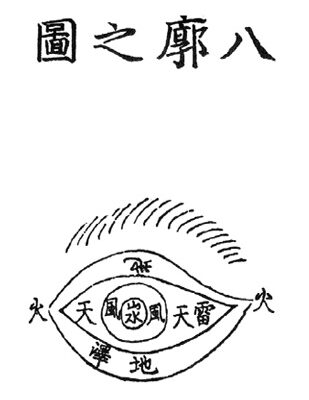
The heaven region belongs to lungs and large intestine; it is in charge of delivering. The earth region belongs to spleen and stomach; it is in charge of water and food. The Fire region belongs to the heart and life gate; it is in charge of storing yang. The Water region belongs to the kidneys; it is in charge of collecting yin. The wind region belongs to the liver; it is in charge of nurturing and changing. The thunder region belongs to the small intestine; it is the passageway of water. The mountain region belongs to the gallbladder; it is in charge of clean and clear in the body. The lake region belongs to the bladder; it is in charge of fluid and humor.
03-1 Heavenly Region 天廓 천곽
The disease of the heaven region is caused by shooting wild geese in the clouds, reading books in moonlight, eating too much food that smells fishy or greasy, or being invaded by cold or heat. The symptoms are the blurry eyesight, painful corners of the eyes which makes them hard to open, and an inability to recognize objects.
03-2 Earthly Region 地廓 지곽
The disease of the earth region is caused by dampness invading the head that leads to cold qi permeating the eyes. The symptoms are the tugging of the corner of the eyes and sores due to stagnated blood.
03-3 Firy Region 火廓 화곽
The disease of the Fire region is caused by the red veins invading the corners of the eye and becoming Hyul Gwan Dong In. The symptoms are redness of the eyes, pain in the eyes, and hot tears.
03-4 Watery Region 水廓 수곽
The disease of the Water region is caused by too much effort in fighting, swinging clubs and drawing bows. The symptoms are disturbed vision, dizziness, and too many tears.
03-5 Windy Region 風廓 풍곽
The disease of the wind region is caused by the brain damaged from wind due to the wind blowing through the window on the head while a person is sitting or lying down. The symptoms are itching of the black parts of the eyes, sores of both eyelids, dim eyesight and lots of tears.
03-6 Thunderous Region 雷廓 뇌곽
The disease of the thunder region is caused by not putting the head on the pillow properly or having sexual intercourse while being drunk, which leads to the overflowing of the veins and pathogenic wind invading the inside. The symptoms are swelling of both corners of the eyes, sores on the eyelids, and Do Chup Gwon Mo and No Yuk Ban Jung.
03-7 Mountainous Region 山廓 산곽
The disease of the mountain region is caused by being hit, stabbed or bumped. The symptoms are extra flesh on the eyelids which cover both eyes. If this is not treated early, the vision will be obstructed and become dark; the stagnated blood will invade the eyes.
03-8 Lake Region 澤廓 택곽
The sickness of the lake region is caused by a yang-toxin knotted inside the body in winter that has lasted to spring. It could also be caused by eating too much hot food. The symptoms are fluid in the brain getting thick that cause bloody tears, blurry vision, eyesight interrupted with shades of objects like bees and dark flowers.
04 The Eyes Belong to the Five Viscera 眼睛屬五臟 눈은 오장에 속한다
① The red part of the inner corner of the eye belongs to the heart; the white of the eye belongs to the lungs; the black of the eye belongs to the liver; the eyelids belong to the spleen, and the pupils belong to the kidneys.
② The white parts of the eyes belong to the lungs, which is called Gi-ryoon (氣輪, wheel for qi). The red parts belong to the heart, and it is where the veins flow. The black parts can be separated; the outer-most parts which look slightly blue, like the ring around the moon, belong to the liver. The middle dark parts belong to the kidneys and inner-most, the pupils, belong to the gallbladder.
05 Outer and Inner Corners of the Eyes 眼有內外眥 내자와 외자
① Among the four corners of the eyes (眥), the outer corner is the acute corner (銳眥) and the inner corner is simply the inner corner (內眥). The upper eyelid is called the outer corner (外眥), and the lower eyelid is called the inner corner (內眥).
② The bladder is the origin of the upper eyelid, and the stomach is the origin of the lower eyelid.
③ The corners of the eye are the roots of the eyelids and eyelashes around them.
④ The inner corner of the eye (目內眥) is where the bladder meridian begins; it is rich in blood and short in qi. The outer core of the eye (目外眥) is where the gallbladder meridian begins; it is short in blood and rich in qi. The upper eyelid belongs to the bladder meridian, which is why it is rich in blood and short in qi; the lower eyelid belongs to the stomach meridian which is why it is rich both in blood and qi. The three meridians all gather in the eyes, but only the liver meridian is connected to the eye system (目系). The meaning of being rich in blood is that bladder and stomach qi are excessive, and the meaning of being short in blood is that liver qi is deficient. This is the reason for using the bladder and stomach meridians when letting blood out; they are rich in blood. The reason of not using the gallbladder meridian in such cases is because it is short in blood. When the bladder and stomach meridians are used for a litte bloodletting, it enables better vision, but if the gallbladder meridian is used for bloodletting, it makes the vision worse.